

Firefly Conservancy
Glow-Worms and Flashing Lights: The Hidden Diversity of Fireflies
May
When we think of fireflies, we picture a magical, airborne dance—tiny golden flashes flickering against the twilight canopy. This aerial display is the hallmark of the “lightning bug,” a creature that has captivated human imagination for centuries. However, if you only look up at the flashing canopy during a Magaliesberg summer night, you are missing half the story.
Beneath the flashing males, hidden within the damp leaf litter and low-hanging fynbos, lies a quieter, steadier beacon: the glow-worm. To truly understand these “Timekeepers of the Evening,” we must look beyond the airborne flashes and explore the hidden, diverse world operating right at our feet.
Dispelling the Myth: Neither Worm nor Fly
The first step in understanding the hidden diversity of fireflies is unraveling their names. A firefly is not a fly, and a glow-worm is not a worm; both are actually soft-bodied beetles belonging to the family Lampyridae. Southern Africa is home to approximately 30 distinct species of these bioluminescent beetles.
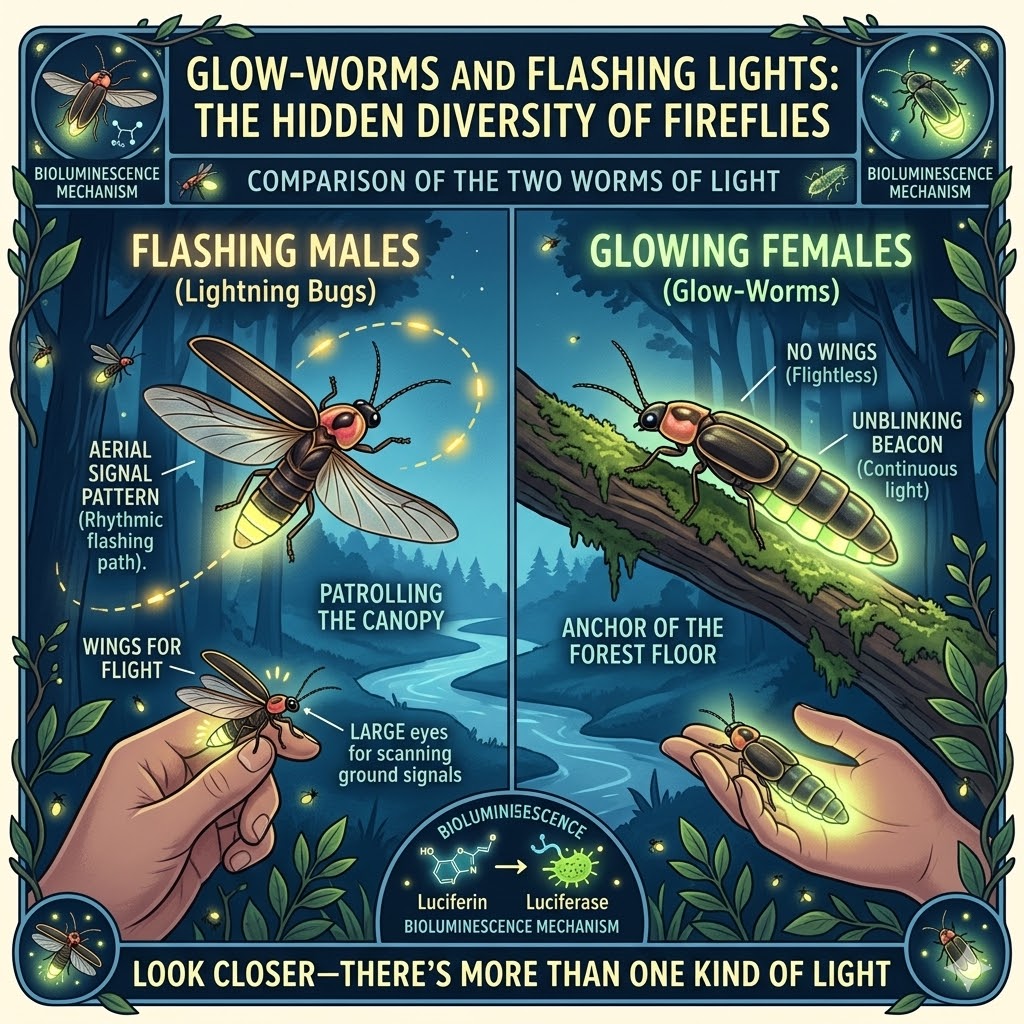
The term “glow-worm” frequently refers to the adult, flightless females of certain firefly species, whose wingless bodies strongly resemble the insect’s larval stage. While male fireflies undergo a complete physical transformation that grants them wings and large, bulbous eyes, the females of many species remain grounded. This extreme physical difference between the sexes—known as sexual dimorphism—means that two radically different life experiences are playing out simultaneously within the exact same landscape.
The Language of Light: Flashing vs. Glowing
Because they occupy different physical spaces—the air and the earth—the males and females communicate using entirely different dialects of light.
-
The Aerial Flashers: Winged male fireflies utilize controlled flashes of light to patrol the air. They use these rhythmic, blinking patterns as a way to broadcast their presence across wide areas of the forest canopy.
-
The Grounded Glowers: Because the flightless females cannot take to the air to find a mate, they rely on a different strategy. Hidden beneath the undergrowth, the female glow-worm emits a bright, continuous, and steady light. She acts as a grounded lighthouse, waiting patiently for a male to notice her signal.
This dynamic dictates their physical evolution. The flying males have developed highly adapted, enlarged eyes specifically designed to scan the dark forest floor beneath them, searching for the steady, unblinking glow of a hidden female.
The Chemistry of the Cold Light
Whether it is a rapid flash in the sky or a steady glow on the ground, the biological machinery behind the light is identical. Inside specialized light organs called lanterns, a chemical compound called luciferin reacts with an enzyme known as luciferase, alongside adenosine triphosphate (ATP) and oxygen.
This internal oxidation produces bioluminescence—a “cold light” that is incredibly efficient, generating brilliant illumination without losing any energy to heat. Remarkably, the larvae of all firefly species also possess this ability, though they often use their glow as a warning to predators rather than a mating call.
Two Worlds in One Landscape
Understanding this diversity fundamentally changes how we experience a firefly emergence. The landscape is not simply “filled with fireflies.” It is a highly structured, stratified ecosystem. The winged males own the vertical space, writing frantic, flashing messages against the dark sky. Meanwhile, the wingless females own the horizontal space, anchoring the forest floor with their steady, ancient glow.
The next time you find yourself standing near the banks of River & Lily after the first rains, don’t just look up at the blinking canopy. Cast your gaze downward into the dark tangles of the undergrowth. Look closer—there’s more than one kind of light.
References
Britannica, T. Editors of Encyclopaedia. (2026). Luciferase. Encyclopedia Britannica. https://www.britannica.com/science/luciferase
Fallon, C. E., et al. (2024). Illuminating firefly diversity: Trends, threats and conservation strategies. Insects, 15(1), 71. https://doi.org/10.3390/insects15010071
Guevarra, M. C. D., et al. (2022). Ecology and diversity of Lampyridae (Firefly): Checklist, state of knowledge, and priorities for future research and conservation. Biodiversity Journal, 13(2), 409–416. https://doi.org/10.31396/Biodiv.Jour.2022.13.2.409.416
Mayes, C. (n.d.). Fireflies 2. Ingwelala Fauna & Flora. https://ingwelala.co.za/archives/fauna-flora/fireflies-2.html
Nunes, R., et al. (2024). How to overcome a snail? Identification of putative neurotoxins of snail-feeding firefly larvae (Coleoptera: Lampyridae, Lampyris noctiluca). PMC. https://pmc.ncbi.nlm.nih.gov/articles/PMC11209139/
Ohba, N. (2012). Sexual dimorphism, mating systems, and nuptial gifts in two Asian fireflies (Coleoptera: Lampyridae). PubMed. https://pubmed.ncbi.nlm.nih.gov/22985863/