

Firefly Conservancy
The First Rain
May
The First Rain: The Dark Alchemy of the Magaliesberg
In the Magaliesberg, one of the oldest mountain ranges on Earth, the arrival of the first summer rain is not merely a change in weather; it is a violent, necessary awakening. For months, the Highveld landscape remains a study in brittle browns and expectant silence, holding its breath until the first massive thundershower cracks the sky. To the casual observer, the fireflies that appear shortly after are a whimsical magic trick. In reality, they are the result of a precise, predatory alchemy triggered by the storm.
The Sensory Shift: Petrichor as a Biological Bell
The transition begins with the scent. As the first heavy drops strike the parched soil, they release petrichor—a complex fragrance born from geosmin and plant oils. This scent is the primary signal that the long drought has broken. In the Magaliesberg, this sensory shift is electric. The air cools instantly, the dust is hammered into the earth, and the silence of the dry season is replaced by the rhythmic drum of water against protea leaves and mountain quartzite.
For the life cycles hidden beneath the surface, this rain is a “biological bell.” The moisture provides the mechanical necessity for movement in a world that has been frozen in dormancy.
The Predatory Prelude: Moisture, Snails, and Venom
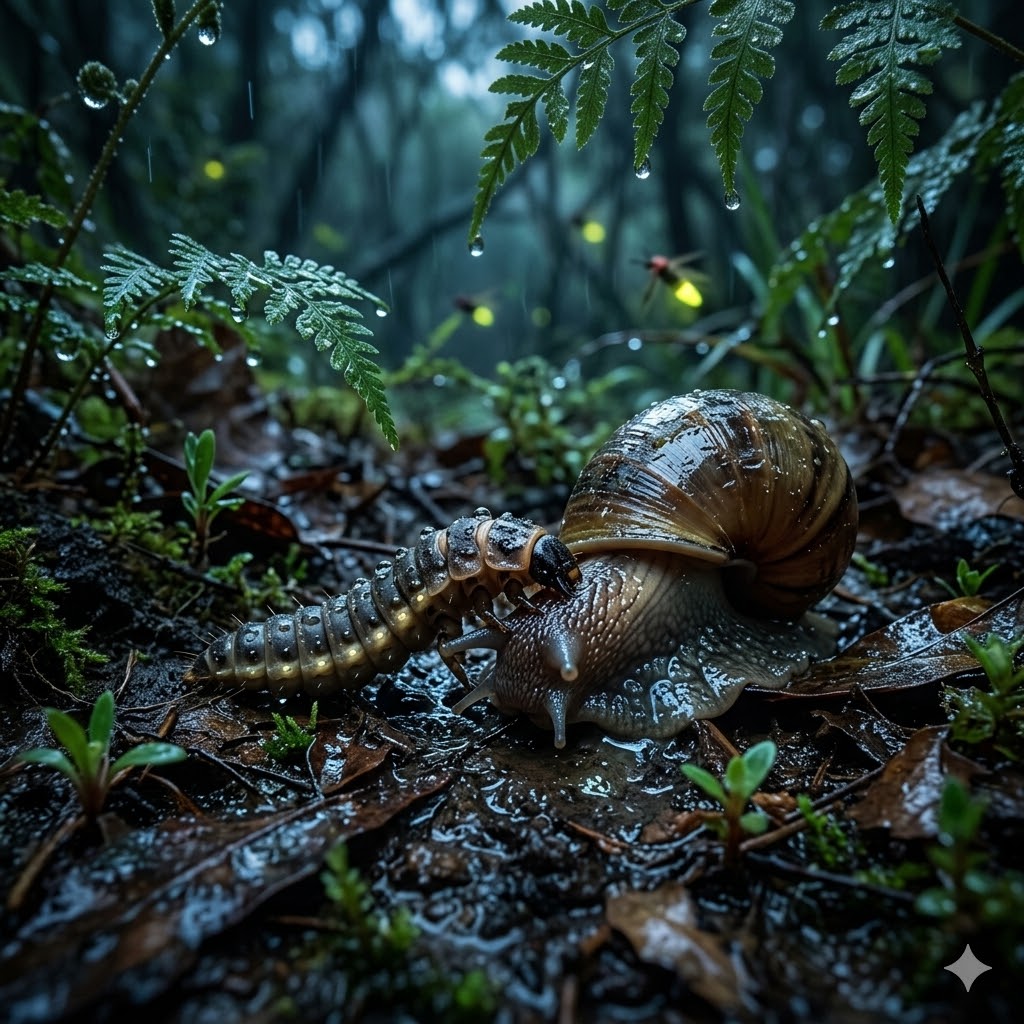
To understand why fireflies follow the storm, one must look away from the light and toward the mud. Fireflies spend the vast majority of their lives—often up to two years—not as ethereal lights, but as flightless, ground-dwelling larvae known as glowworms. These larvae are far from delicate; they are voracious, armored predators equipped with grooved mandibles designed for one specific purpose: the hunting of soft-bodied invertebrates like snails and slugs.
The “First Rain” is the catalyst for this food chain:
-
Moisture: The rain saturates the leaf litter and topsoil, creating the humid microclimates required for snails and slugs to emerge from their own protective estivation.
-
The Prey: In South Africa, indigenous fireflies like Aspisoma ignitum are known to track and hunt species such as the Giant African Snail.
-
The Attack: Once the rain activates the snails, the firefly larvae strike. They use their mandibles to inject a paralyzing neurotoxin, effectively liquefying the prey’s tissues for consumption.
This predatory surge provides the final, massive protein boost the larvae need to enter the pupal stage. Without the rain to move the snails, the firefly life cycle remains stalled.
The Emergence: From the Mud to the Canopy
The final act of this seasonal story is the emergence of the adult beetles. The “First Rain” softens the sun-baked Highveld ground, which would otherwise be too hard for the delicate adults to crawl through after pupation. As the humidity remains high in the days following the storm, the adults emerge to begin their brief, luminous mating dance.
At River & Lily, this connection is visceral. The landscape after rain is a transformed world where the smell of wet earth is the precursor to a light show built on months of predatory survival. The fireflies do not just “appear”; they are the crowning achievement of a landscape that has successfully converted rain and snails into bioluminescent starlight.
Experience the landscape after rain. Step into the Magaliesberg twilight and witness the ancient signals of a world reborn.
References
da Silveira, L. F. L., et al. (2021). Examining the Predatory Relationship Between the Indigenous Firefly (Aspisoma ignitum) and the Invasive Giant African Snail (Achatina fulica). Journal of Agricultural Science, 15(5). https://ccsenet.org/journal/index.php/jas/article/download/0/0/48603/52328 Cited by: 0 (Manual Check Required)
Firefly Atlas. (n.d.). Firefly Life History. Firefly Conservation & Research. https://www.fireflyatlas.org/learn/firefly-life-history
Missouri Department of Conservation. (n.d.). Fireflies (Lightning Bugs). Field Guide. https://mdc.mo.gov/discover-nature/field-guide/fireflies-lightning-bugs
The Times of India. (2026, April 25). India has cut malaria cases sharply but not fully eliminated it. Where do the gaps remain? https://timesofindia.indiatimes.com/india/india-has-cut-malaria-cases-sharply-but-not-fully-eliminated-it-where-do-the-gaps-remain/articleshow/130512597.cms