Firefly Conservancy
Light Management at River & Lily Firefly Conservancy
May
At River & Lily Firefly Conservancy, darkness is not treated as an absence. It is treated as habitat.
Fireflies depend on natural darkness to communicate, find mates, move through the landscape, and complete their life cycle. Their soft glow is not decorative; it is a biological signal. When artificial light becomes too bright, too white, or too widely spread, it can interfere with those signals and reduce the quality of the habitat they depend on. Research and firefly conservation guidance identify artificial light at night as one of the pressures affecting firefly populations, alongside habitat loss, pesticides, and land-use change.
For this reason, River & Lily does not approach lighting as a standard hospitality feature. It is managed carefully, with the aim of giving visitors just enough light to move safely while protecting the night environment that fireflies need.
Why light matters to fireflies
Fireflies communicate through light. Many species use specific flashes to locate and recognise one another during courtship. Artificial lighting can mask these natural signals, especially when lights are bright, exposed, blue-white, or directed into vegetation. Conservation guidance recommends reducing unnecessary outdoor lighting during firefly season, using low-level lighting, shielding fixtures, and avoiding bright blue-white LEDs near firefly habitat.
In a firefly conservancy, this means the goal is not to light the forest beautifully for people. The goal is to protect the darkness beautifully enough for fireflies.
The River & Lily approach
River & Lily uses a low-impact lighting philosophy across the Firefly Habitat experience. The cabins, paths, viewing areas, and arrival spaces are designed around the principle of minimum necessary light.
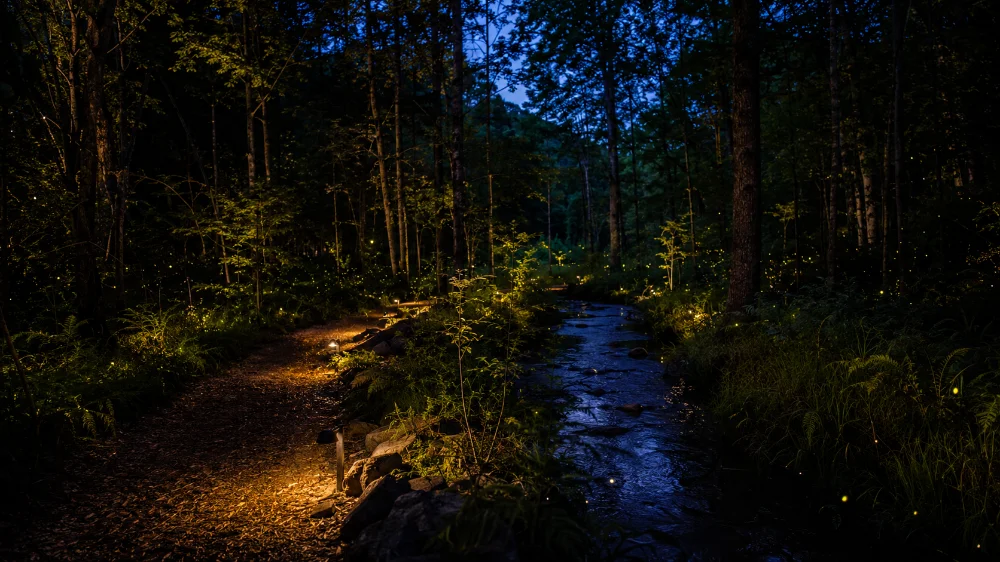
Lighting is kept low, warm, downward-facing, and carefully positioned. Instead of flooding paths or trees with light, small pools of gentle illumination guide guests only where needed. This allows visitors to move safely without washing the forest in artificial brightness.
Where lighting is required, it is managed according to five basic principles:
Low level
Lights are kept as dim as practical, providing enough visibility for walking without creating glare or unnecessary brightness.
Warm tone
Warm, soft lighting is preferred over cold white or blue-toned lighting, because blue-rich light is more disruptive to nocturnal environments and contributes strongly to skyglow.
Downward direction
Light is aimed at the ground, not into the trees, sky, river corridor, or surrounding vegetation. Shielded and downward-facing fittings help reduce light spill into the habitat.
Short duration
Lights are used only when needed. Guest movement areas may use controlled lighting, while the firefly viewing experience itself is kept as dark and natural as possible.
No unnecessary decorative lighting
River & Lily avoids lighting that may look attractive to humans but disturb the habitat, such as bright garden uplighters, tree lights, strong façade lighting, or exposed bulbs near sensitive areas.
Visitor movement without disturbing the habitat
The Firefly Habitat experience is intentionally slow and guided. Guests arrive in the late afternoon, settle into their cabins, and are introduced to the conservancy before nightfall. This reduces the need for bright navigation lighting after dark.
During the night walk, the forest is kept quiet and dark. The walk is guided, controlled, and silent, with no unnecessary artificial light. Visitors are encouraged to let their eyes adjust naturally to the darkness. This helps them experience the forest in the way nocturnal life experiences it — softly, slowly, and without glare.
Where practical, paths are defined by texture, edging, natural boundaries, or very low-level markers rather than bright overhead lights. Viewing decks and clearings are treated as observation spaces, not entertainment spaces. Guests sit quietly and allow the fireflies to appear naturally.
This is central to the River & Lily experience: the visitor does not arrive to command the landscape. The visitor arrives to become still enough to notice it.
Cabin lighting
The three Firefly Habitat cabins are designed to feel warm and inviting while limiting their effect on the surrounding forest. Interior lighting is soft and controlled, with curtains or screening used where needed to reduce light spill through glass doors and windows.
Exterior cabin lighting is kept subtle and functional. The aim is to help guests arrive, enter, and move safely around the deck without turning the cabin into a beacon in the forest. Deck and entrance lighting should remain low, warm, and directed downwards.
Guests are also encouraged to take part in the conservation effort by closing curtains at night, switching off unnecessary lights, and avoiding phone torches during firefly viewing.
Reforestation and habitat repair
Light management is only one part of firefly conservation. Fireflies also need suitable habitat.
At River & Lily, reforestation and habitat restoration are part of the long-term conservation vision. Fireflies are closely connected to moisture, vegetation structure, soil health, leaf litter, and undisturbed areas. Many firefly larvae live close to the ground, where they depend on damp, sheltered microhabitats and a healthy food web.
Reforestation helps create the conditions that fireflies need by restoring shade, improving moisture retention, reducing soil temperature extremes, protecting river and wetland edges, and building a richer understory. Trees also help screen artificial light, creating darker pockets and more protected corridors through the landscape.
The aim is not simply to plant trees for appearance. It is to rebuild a functioning forest edge and riverine habitat — one that supports insects, birds, amphibians, soil organisms, and the quiet night life that makes River & Lily special.
A living conservancy, not just accommodation
Firefly Habitat is more than a place to stay. It is a carefully managed nature experience within a conservancy setting.
Every decision, from the placement of a path light to the way guests are guided through the forest, is shaped by one question: does this protect the fireflies and their habitat?
The answer must be yes.
By combining sensitive lighting, guided visitor movement, education, reforestation, and habitat restoration, River & Lily Firefly Conservancy offers guests a rare experience: the chance to witness fireflies in a landscape where darkness is respected, nature is allowed to lead, and conservation is built into every part of the stay.