The Secret Life of Fireflies
A closer look at South Africa’s glowing beetles
Fireflies—often called lightning bugs—are among nature’s most enchanting creatures. Despite their name, they are neither flies nor true bugs, but beetles belonging to the family Lampyridae. Found across South Africa, these small insects transform warm evenings into quiet light shows, especially in damp, undisturbed environments.
Beyond their beauty lies a complex life cycle, fascinating behaviour, and an ecological role that is often overlooked.
Life Cycle: From Hidden Hunter to Flicker of Light
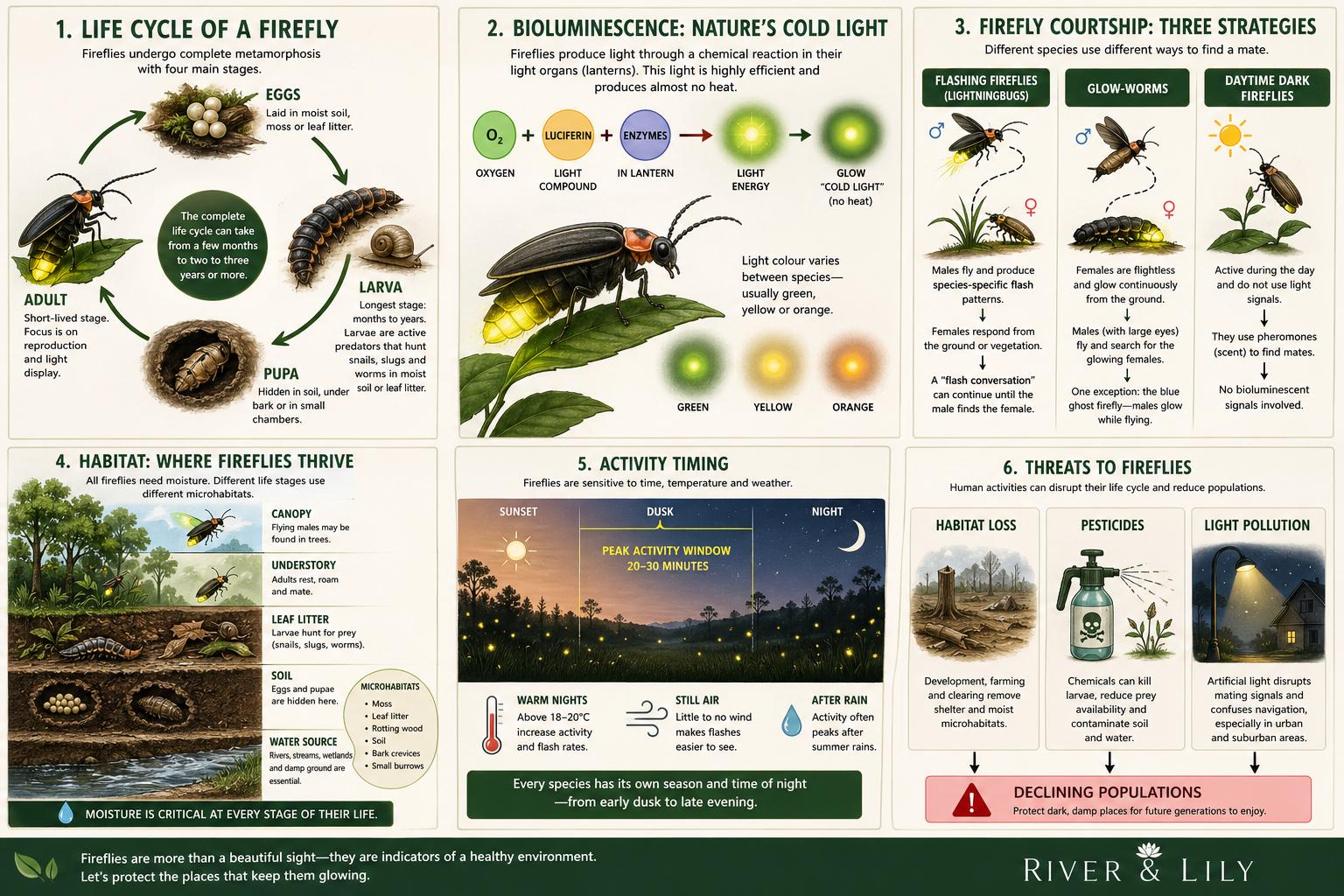
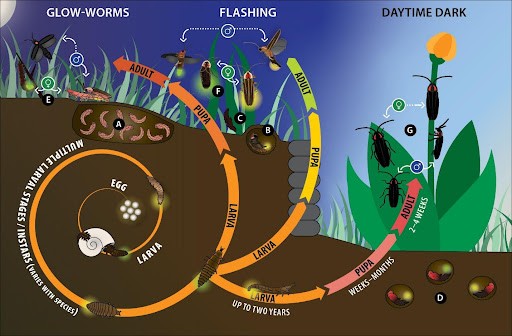
Fireflies undergo complete metamorphosis, progressing through four distinct stages: egg, larva, pupa, and adult.
This process can take anywhere from a few months to two or even three years, depending on the species and environmental conditions. What surprises most people is that fireflies spend the vast majority of their lives—not as glowing adults—but as larvae.
In this stage, they are highly effective predators. Living in moist soil, leaf litter, or along riverbanks, firefly larvae hunt snails, slugs, and worms. They inject their prey with paralysing toxins and then use digestive enzymes to break down the body before consuming it. This makes them important natural pest controllers in healthy ecosystems.
Pupation occurs in sheltered spaces such as shallow soil chambers, under bark, or within dense vegetation. From here, they emerge as adults—often for a brief and singular purpose: reproduction.
Bioluminescence: Nature’s Cold Light
Fireflies produce light through a highly efficient biochemical reaction that takes place in specialised light organs known as lanterns. This process combines oxygen, a light-emitting compound called luciferin, and enzymes to produce what is often referred to as “cold light”—light without heat.
The colour of this glow varies between species, typically ranging from green to yellow and sometimes even orange-red. Interestingly, the timing of their activity often correlates with light colour. Species active at dusk tend to emit more yellow tones, which stand out against green vegetation, while those active in full darkness emit greener light.
Not all adult fireflies glow, however. While all larvae are bioluminescent, some adult species rely on other methods of communication.
Courtship: Light, Signals, and Strategy
Firefly courtship is one of the most remarkable communication systems in the natural world. Different species have evolved distinct mating strategies, which generally fall into three categories:
Flashing fireflies are the most familiar. Males fly through the air, emitting species-specific flash patterns. Females, usually perched on vegetation, respond with their own signals. This “flash dialogue” can continue until the male locates the female.
Glow-worm fireflies take a different approach. Here, the females are flightless and emit a steady glow from the ground. Males—often with enlarged eyes—fly in search of these stationary signals.
Daytime dark fireflies rely less on light and more on chemical signals (pheromones) to find mates.
Some species even take a more deceptive route. Certain females mimic the flash patterns of other species to lure unsuspecting males—only to prey on them instead of mating.
Timing is critical. Some fireflies are active for only 20–30 minutes at dusk, while others begin later and remain active for several hours. Temperature also plays a role, with warmer nights increasing activity and flash frequency.
Habitat: Where Fireflies Thrive
Despite their diversity, all fireflies share one essential requirement: moisture.
They are most commonly found in environments such as:
- Riverbanks and wetlands
- Forest edges and shaded gullies
- Damp grasslands and meadows
- Areas with rich leaf litter or decaying wood
Each life stage depends on slightly different microhabitats. Eggs and larvae favour moist soil and organic matter, while pupae may develop underground or attached to vegetation. Flightless females remain close to where they were born, while winged males can travel more widely through the landscape.
In South Africa—and particularly in regions like the Magaliesberg—fireflies are closely tied to seasonal rainfall. Their activity peaks during warm, humid evenings following summer rains, when conditions are ideal for both survival and reproduction.
A Delicate Balance
Fireflies are more than just a beautiful sight—they are indicators of environmental health. Their reliance on moisture, darkness, and unpolluted habitats makes them especially vulnerable to:
- Habitat loss
- Pesticide use
- Light pollution
Even small changes, such as increased artificial lighting, can disrupt their mating signals and reduce populations.
Why They Matter
Fireflies play an important ecological role as predators of pest species like snails and slugs, helping maintain natural balance in gardens and wild spaces alike. Their presence is often a sign of a thriving, biodiverse environment.
For places like River & Lily, where nature, water, and quiet landscapes come together, fireflies are part of something deeper—a reminder that even the smallest creatures contribute to the magic of the natural world.